|
Sample Data Sheet Overview & Objectives | Teacher Prep | Protocols | Useful References
Download the Microsoft Word version of this data sheet
Population 1
Observed Genotype Frequencies
Allele Frequencies
Hardy Weinberg Expected Genotype Frequencies
Population 2
Observed Genotype Frequencies
Allele Frequencies
Hardy Weinberg Expected Genotype Frequencies
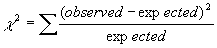
Chi Square Analysis of Expected and Observed Frequencies The first question that population geneticists ask after they collect genotype data for a population is whether or not the population is in Hardy Weinberg equilibrium for that locus. This test involves comparing the observed and expected frequencies that you calculated for each of the populations above. Recall that a population in Hardy-Weinberg equilibrium for a given genetic locus means that there is random mating (with respect to that locus), no selection, no mutation, no migration and a population large enough to avoid the random effects of genetic drift. Population geneticists generally use population genetic profiles to determine how reproductively isolated populations are from one another. However, if selection is operating on a locus and one finds differences between populations at that locus, the difference may be due to selection acting differently on the two populations, rather than the result of reproductive isolation between the two populations. We will calculate a test statistic called a chi-square (X2). The chi-square is defined as follows:
We will then determine whether the value of the test statistic is significant. The chi-square value gets larger as the differerence between the observed and expected values gets larger. For a two allele locus like the one we just examined it turns out that if the X2 value is greater than 3.84 there would less than a 5% chance of getting a deviation between the expected and observed values that high by chance alone, which means the population is not in HWE. Is your population in HWE? Project Description | Overview & Objectives | Protocols | Data Sheet | Useful References |